


3D Rendering vs Photography: The Future Of Product Visuals
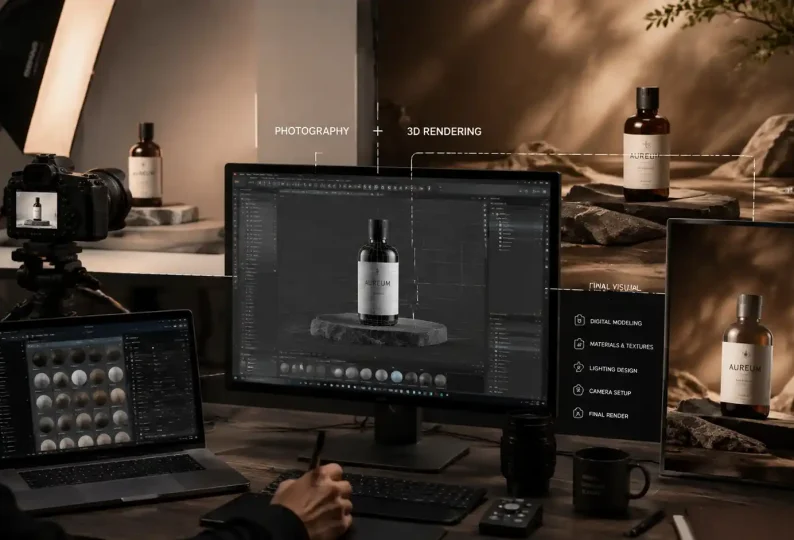
Introduction: The Way Brands Create Product Visuals Is Changing
For decades, product photography was the standard language of commerce. If a company wanted to show a product, the process was straightforward: manufacture the product, prepare a studio, organise a photoshoot, and capture the final images.
That workflow created some of the most recognisable product campaigns in the world.
However, the expectations placed on brands today are very different. Companies are no longer creating one image for one catalogue. They need product visuals for Amazon listings, websites, paid advertisements, social media, launch campaigns, animations, and future product variations.
The question is no longer simply whether a product can be photographed.
The question is whether a brand can create enough high-quality visual content, quickly enough, while maintaining consistency.
This is where 3D rendering has transformed the creative process.
3D rendering does not exist because photography failed. Photography remains an incredibly powerful tool. Instead, 3D gives brands another level of control, flexibility, and scalability.
The future of product visuals is not about choosing one technology over another. It is about understanding which tool creates the strongest business outcome.
The Strength Of Traditional Product Photography
Photography has something powerful: reality.
A photograph captures the physical product exactly as it exists. It captures natural textures, real environments, and authentic interaction.
For many categories, this emotional connection is extremely valuable. Food, fashion, cosmetics, and lifestyle products often benefit from seeing real people interacting with real products.
Photography tells customers: this exists, this is real, this is how it feels in the world.
That authenticity is one of photography’s greatest strengths.
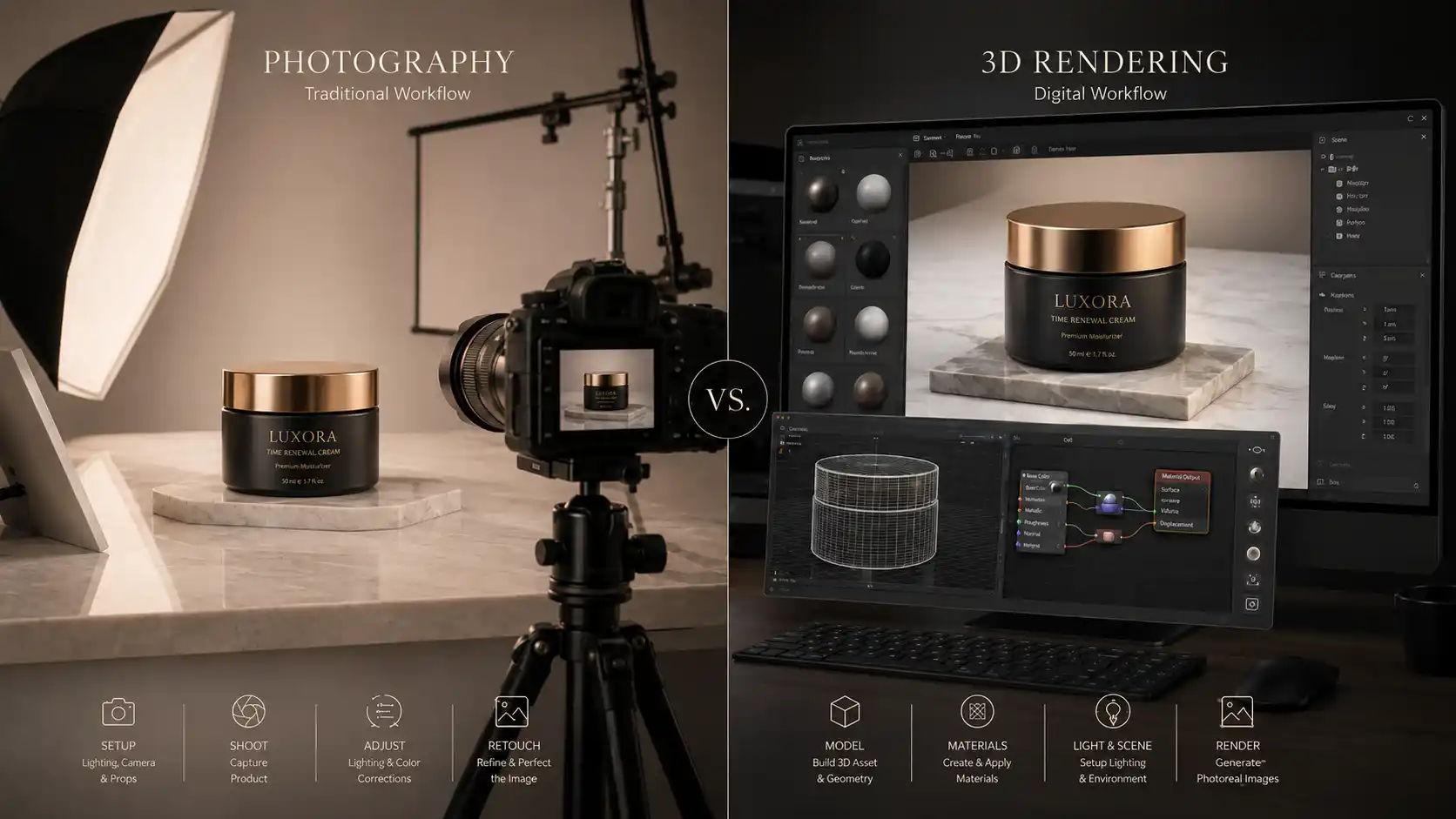
However, photography also comes with limitations. Every new variation, colour, angle, and environment often requires additional production. Physical samples must exist. Studios must be booked. Lighting must be recreated. Locations and logistics must be managed.
For brands with large product catalogues or constantly changing products, this can become expensive and slow.
Where Traditional Photography Starts To Struggle
Modern ecommerce requires speed.
Imagine a furniture company offering 20 colours, 10 materials, and multiple configurations. Photographing every possible combination could require enormous production resources.
A product launch can also become challenging when physical samples are delayed. Marketing teams may have the product planned months in advance, but photography cannot happen until the physical item exists.
This is one of the biggest advantages of 3D visualization.
A product can be visualised before manufacturing is complete.
Brands can prepare launch assets, advertisements, and ecommerce content earlier in the process.
Understanding 3D Product Rendering
3D rendering creates photorealistic product imagery from digital models. Instead of placing a physical product in front of a camera, artists build a digital version and create the final image inside a controlled virtual environment.
The result can look like photography, but the process is completely different.
Every element can be controlled:
lighting,
camera position,
materials,
background,
environment,
colour variations,
and product configurations.
This level of control allows brands to create visuals that would be extremely difficult, expensive, or impossible to produce traditionally.
Industry discussions around ecommerce visualization increasingly highlight 3D’s advantages for scalable catalogues, product variants, and pre-launch content. citeturn0search0turn0search3
The Biggest Advantage: One Asset, Unlimited Possibilities
The most important difference between photography and 3D is not the final image.
It is the asset behind the image.
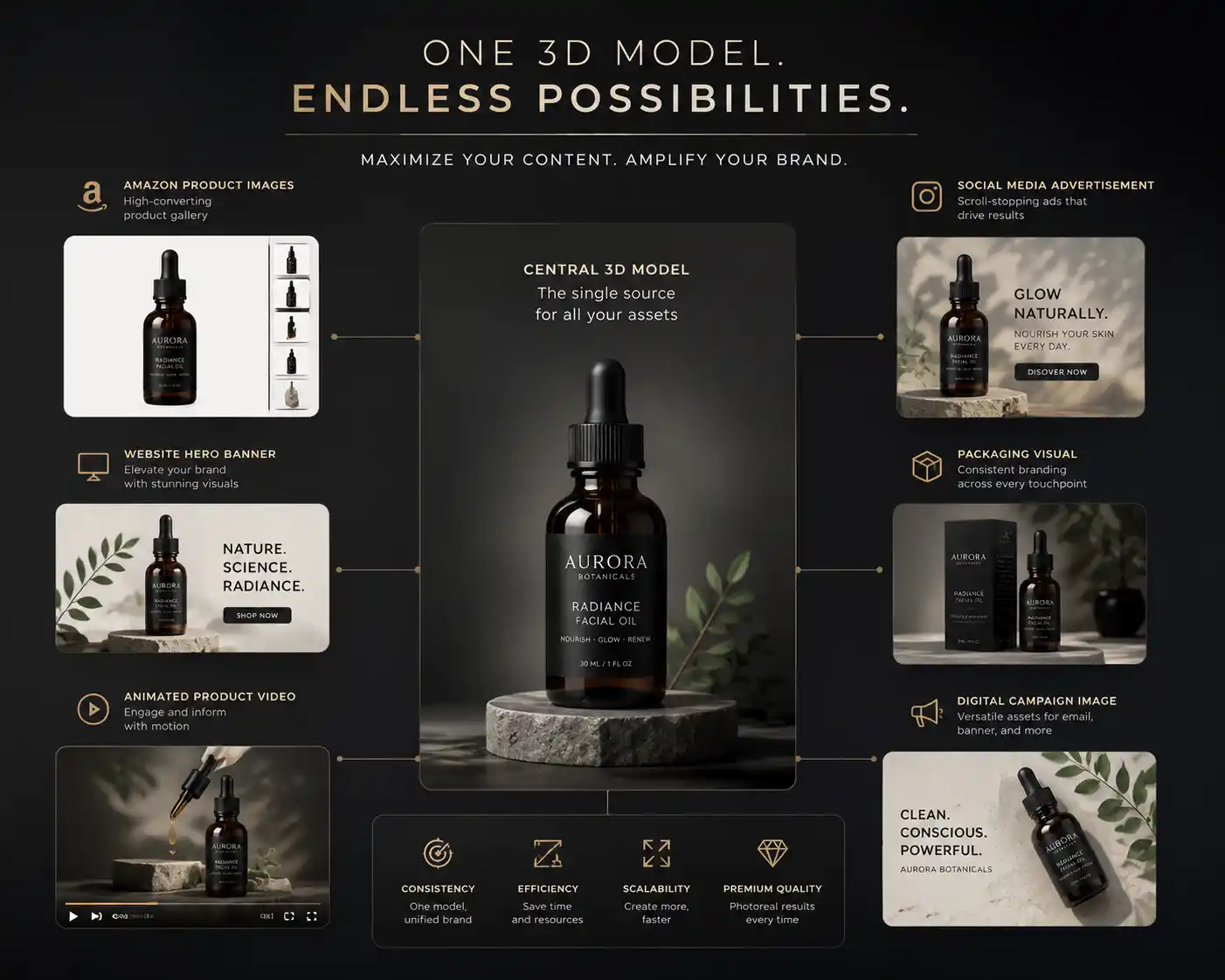
A photograph is usually a finished result. A 3D model is a reusable foundation.
From one accurate 3D model, a brand can create:
– different colours,
– different angles,
– different environments,
– animations,
– advertising scenes,
– marketplace images.
This changes visual production from a series of individual projects into a long-term creative system.
For growing brands, this difference becomes increasingly valuable.
When Should A Brand Choose 3D Instead Of Photography?
3D rendering is especially valuable when a company needs flexibility.
It works exceptionally well for:
products with multiple variations,
products that have not launched yet,
technical products,
premium ecommerce products,
large catalogues,
and brands that need consistent visuals across many channels.
Photography remains the better choice when physical authenticity is the main priority.
The strongest brands often combine both approaches.
They use photography where human connection matters most and 3D where flexibility and scale create an advantage.
The Future Is A Hybrid Visual Strategy
The debate between 3D rendering and photography is often presented as a competition.
In reality, the future is collaboration.
A premium brand might use photography for a hero campaign featuring real people, while using 3D for ecommerce variations, advertisements, and product demonstrations.
This hybrid approach gives brands authenticity and efficiency.
The winning brands will not be the ones that choose the newest technology blindly. They will be the ones that understand how every visual decision supports the customer experience.
Conclusion
Product visuals are no longer simple marketing assets. They are strategic tools that influence trust, perception, and purchasing decisions.
Photography gave brands the ability to capture products beautifully.
3D rendering gives brands the ability to imagine, scale, and communicate products in entirely new ways.
The future belongs to companies that understand visuals are not just pictures.
They are experiences.
Amplify SSV helps brands create premium product visuals through 3D rendering, ecommerce design, and creative direction built for modern markets.
