


Why Great Products Fail With Weak Visuals

Introduction: A Great Product Is Not Enough
A company can spend months, sometimes years, creating an exceptional product. Teams research customer problems, improve materials, test performance, refine manufacturing, and build something they truly believe in.
Then the product reaches the market.
The customer sees a few images on a screen.
That moment creates a difficult reality: customers cannot experience the effort behind a product. They cannot see the late nights, the engineering decisions, or the attention to detail. They only experience the version of the product that is communicated to them.
This is where many excellent products fail.
Not because they are bad products. Not because there is no demand. But because the visual presentation does not allow customers to understand the value.
In ecommerce, perception happens before investigation. A shopper forms an opinion before reading every specification or studying every feature. Visuals become the first layer of communication, and that first impression influences whether someone continues exploring or moves to another option.
Research into online shopping behaviour consistently shows that product imagery plays a major role because visuals help customers evaluate products when physical interaction is impossible. citeturn0search0
The Difference Between Product Quality And Perceived Quality
One of the biggest mistakes businesses make is assuming customers automatically recognise quality.
They do not.
Quality must be communicated.
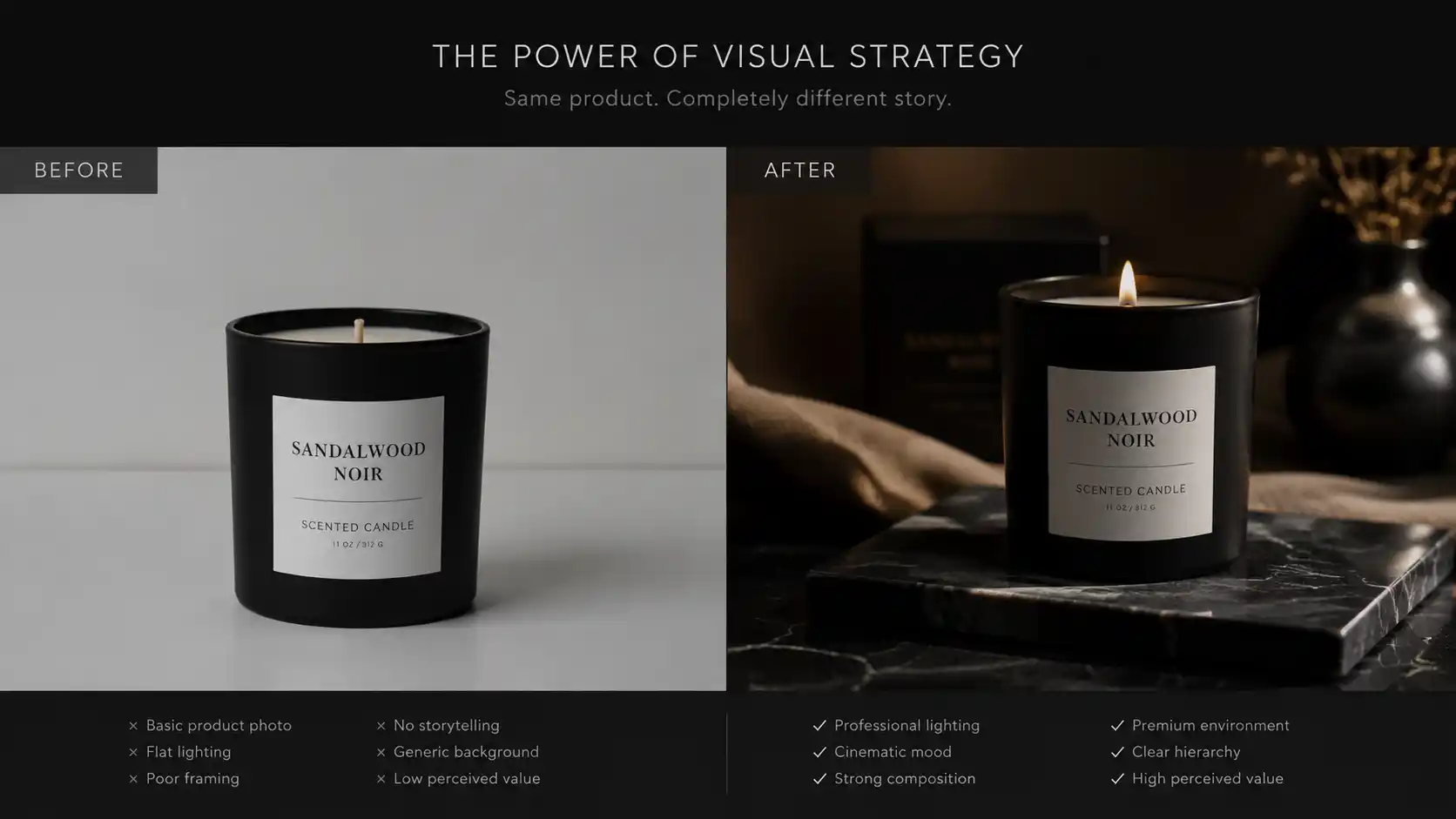
A premium product with poor visuals can appear average. A well-designed product with unclear presentation can look confusing. A technically advanced product can feel ordinary if the customer cannot understand what makes it different.
This does not mean visuals should exaggerate reality. The purpose of strong creative work is not to make a product appear better than it is.
The purpose is to reveal the value that already exists.
Great visual communication creates a connection between what the company built and what the customer understands.
A luxury skincare product is not only a bottle. It represents a routine, confidence, and a feeling of care.
A technology product is not only components and specifications. It represents efficiency, innovation, and a better experience.
The strongest brands understand that customers buy meaning as much as they buy functionality.
Why Customers Judge Before They Read
Online shopping removes many of the experiences that make traditional retail powerful.
In a store, customers can pick up a product, examine details, compare materials, and imagine using it.
Online, images must recreate that confidence.
Every unanswered question creates friction.
How large is the product?
How does it look in real life?
How does it work?
Why is it better than another option?
Can I trust this company?
Weak visuals leave these questions unanswered.
Strong visuals guide the customer through the decision.
This is why product imagery is not simply a creative task. It is part of conversion strategy. A gallery is performing the job of a salesperson by explaining, demonstrating, and reassuring.
A product page with strong visuals reduces uncertainty. A product page with weak visuals forces the customer to do more work.
And when customers have too much uncertainty, they hesitate.
The Hidden Cost Of Competing On Price
Many brands believe they are competing against competitors with cheaper products.
Often, they are actually competing against competitors with better communication.
When customers cannot clearly understand why one product is better, price becomes the easiest comparison.
This creates a difficult cycle. Brands lower prices to compete, reducing margins, while the real problem remains: customers never saw enough value.
Premium visual presentation changes that equation.
When a product is presented with confidence, clarity, and consistency, customers can understand why it deserves attention.
The difference between a commodity and a premium brand is often not only the product itself. It is the story surrounding the product.
Building Visual Trust Across Every Touchpoint
Strong brands do not treat each image as an isolated piece of content.
They create systems.
The Amazon listing, website, advertising campaign, packaging, and social media presence should feel connected.
When customers repeatedly see a consistent visual language, recognition increases. The brand feels more established and trustworthy.
Consistency communicates professionalism.
A company that invests in thoughtful presentation signals that it cares about details. Customers often use these signals when deciding whether a business is reliable.
This is especially important for newer brands competing against established companies. Strong visuals can help create credibility before a customer has previous experience with the brand.

Why Beautiful Images Alone Are Not Enough
There is an important distinction between attractive visuals and effective visuals.
A beautiful image can capture attention.
A strategic image can create action.
Effective product visuals are designed around customer questions and buying decisions.
The image should have a purpose.
A lifestyle image should help customers imagine ownership.
A comparison graphic should explain an advantage.
A detail image should prove quality.
A feature visual should communicate a benefit quickly.
The strongest creative work combines aesthetics with strategy.
It understands that design is not only about making something look impressive. It is about making something easier to understand.
How Premium Brands Think Differently
The world’s strongest brands understand that presentation is part of the product experience.
Companies like Apple, Dyson, and leading luxury brands invest heavily in how customers encounter their products because they understand perception influences behaviour.
Their visuals are not created randomly. Every choice supports a positioning.
The lighting, composition, environment, and storytelling all reinforce what the brand represents.
This approach is available to businesses of every size. A smaller brand does not need the budget of a global company to think strategically. It needs the same understanding: customers need a clear reason to believe in the product.
Conclusion: Make The Value Visible
Great products deserve to be understood.
A weak visual presentation creates distance between the product and the customer. A strong visual experience closes that gap.
The brands that succeed are not only the ones that create better products. They are the ones that communicate their value clearly.
In a marketplace where attention is limited and competition is everywhere, visuals are not an afterthought.
They are the bridge between what a product is and what customers believe it can become.
Amplify SSV helps brands transform products into premium visual experiences through 3D rendering, ecommerce design, and strategic creative direction.
