


Haircare Product Photography: 12 Ideas for Serums, Masks and Supplements
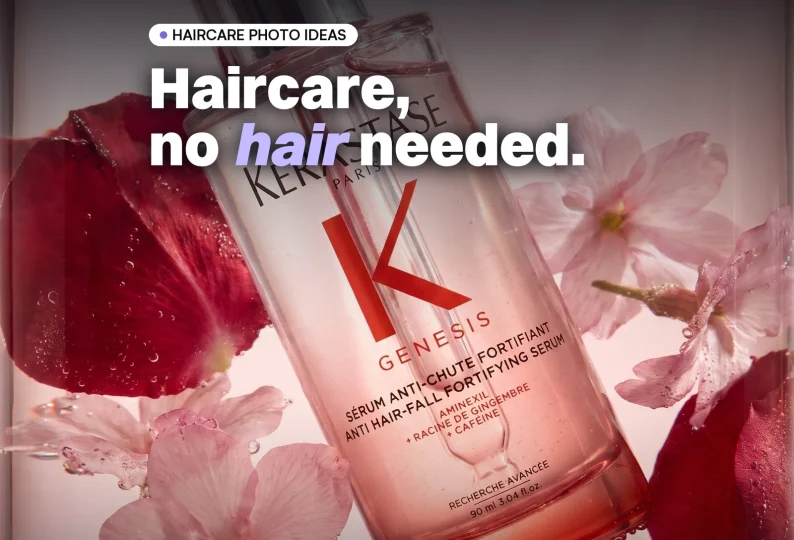
Haircare has a visual problem: the result happens on someone’s head, weeks later, and the product itself is often a bottle, a jar or a tub that looks like every other one on the shelf. Great haircare images solve that by selling the feeling of the formula and the ritual around it. Here are 12 haircare product photography ideas I use, each shown with a concept visual I created for Kérastase, EVA NYC and Nutrafol, with no models needed.
Key takeaways
- Sell the formula: rich mask textures, glossy serums and drops are your strongest images.
- Use flowers, water and light to signal the mood: nourishing, fresh or luxurious.
- Show the tools of the routine, like combs and brushes, so the product feels part of real hair care.
- For hair supplements, show the format and a calm daily ritual, never before/after promises.
- Benefit callouts must use the claims on your packaging, word for word.
See more haircare work on my haircare product visuals page.
Texture and concept: ideas 1 to 6
- Overflowing texture: a hair mask so rich it spills over the jar says “deep conditioning” at a glance (EVA NYC).
- Texture swirl: the open jar with a spatula swirl shows the consistency buyers want to feel.
- Floating pack: lids lifting off the jar add movement and make a simple tub feel premium.
- Flowers and petals: a serum nestled in roses signals care and indulgence (Kérastase Genesis).
- Underwater: the bottle in clear water with petals reads fresh, pure and light.
- Hard light and shadows: warm sun and leaf shadows on a plain wall turn one bottle into a mood.

Why texture sells haircare
Most haircare is chosen on how it will feel: light or rich, oily or weightless, creamy or gel. A texture image answers that instantly, and it sets honest expectations, which means happier customers and fewer returns. For masks and creams, show a swirl or an overflow. For serums and oils, show the glossy liquid and a drop from the pipette. In 3D, the texture can be matched to your real formula’s color, shine and thickness.
Routine and benefits: ideas 7 to 12
- Dropper in hand: a hand holding the serum with the pipette out shows size and use in one shot.
- With the comb: a flat lay with a wooden comb or brush places the product in a real hair routine.
- Vanity routine: a hair supplement next to a hairbrush on a calm vanity (Nutrafol).
- Format close-up: capsules on linen with a glass of water answer “what will I take?”.
- Natural setting: ferns and soft greens for brands built on botanical ingredients.
- Benefit callouts: a bold slide with the key ingredients and benefits from your packaging, for ads and listings.

Hair supplements: what to show and what to avoid
Hair supplements are bought on trust. Show the bottle clearly, the capsule or gummy format, the daily ritual and your ingredients. Avoid dramatic before/after hair images and any promise of regrowth that isn’t on your approved label, because supplement claims are tightly regulated. Every claim on an image should match your packaging and be approved by your team. My guide to supplement listing images covers this in more detail.
Setup notes for all 12 ideas
Here is how I would set up each of the 12 haircare ideas: the listing slot it does the best job in, the light and angle that make it work (in a studio or in 3D), and the mistake I see most often. Use it as a brief for a photographer, or send it to me and I’ll build the shots in 3D.
| Idea | Best slot | Light and angle | Mistake to avoid |
|---|---|---|---|
| Overflowing texture | Gallery 2 (the formula) | Overhead soft light, slight side grazing | Mask texture that looks nothing like the real one |
| Texture swirl | Gallery or A+ | Top-down macro, two side cards | Specular hot spots that hide the texture |
| Floating pack | Ads and social | Soft key with a rim to separate it from the background | Unclear size, so shoppers misjudge it |
| Flowers and petals | Lifestyle or A+ | Warm side light, petals out of focus | Botanicals that suggest ingredients it doesn’t have |
| Underwater | Ads (hydration story) | Backlight through the water, low camera | Bubbles over the label |
| Hard light and shadows | Hero for premium brands | Bare spot through a gobo, no fill | Shadows falling across the product name |
| Dropper in hand | Gallery (how to use) | Soft side light, hand only | A drop size that implies a different dose |
| With the comb | Gallery (routine) | Window light, props kept simple | Props that look included on the main image |
| Vanity routine | Lifestyle slot | Soft daylight, warm practicals in the background | Clutter that hides the bottle |
| Format close-up | Gallery (gummies, capsules) | Light tent or overhead soft box | No size reference for a capsule or gummy |
| Natural setting | Ads and A+ | Sun as rim, reflector in front | Colour drift in the bottle between shots |
| Benefit callouts | Gallery 2–3 | Clean studio light on a plain background | Regrowth claims on a cosmetic product |
Two lighting setups I use for haircare
Top-down diagrams: the product sits in the middle and the camera at the bottom. The same setups work in a studio and in 3D, where I can place every light exactly.
One hard light through a leaf pattern gives the luxury "sunlit vanity" look. Flag the far side so shadows stay deep.
An overhead soft source with white cards on both sides shows the swirl's sheen without hot spots.
No models needed
People-led haircare campaigns are expensive: models, stylists, hair and makeup, a studio and usage rights. None of the 12 ideas above needs a model. They sell the product, the formula and the ritual instead, which works well for listings, product pages and ads. In 3D, you can also create every scene from one accurate model of your bottle or jar, keep the label perfectly sharp, and reuse the setup for new sizes and formulas.
What haircare product visuals cost
With me, a label-accurate main image is $190, a 3D launch set (3 hero renders and 2 lifestyle scenes) starts at $590, and a full Amazon listing set starts at $690. Extra sizes or formulas from the same setup are $90 each. See more on my haircare product visuals page, get your number with the instant estimator, or ask for a fixed quote within 24 hours. No calls needed.
Frequently Asked Questions
What are good haircare product photography ideas?
Overflowing or swirled mask textures, floating packs, flowers and petals, underwater scenes, hard light and shadows, dropper in hand, flat lays with combs and brushes, vanity routines, capsule close-ups, natural settings and benefit callouts.
How do you photograph hair masks and serums?
Show the texture: a swirl or overflow for masks, a glossy liquid and a falling drop for serums. Keep the label sharp and use light that brings out the formula’s shine.
Do haircare images need models?
No. Product, texture and ritual images sell well on listings and product pages, and they avoid the cost of models, stylists and usage rights.
What claims can I show on hair supplement images?
Only claims that are on your approved label and packaging. Avoid before/after hair images and regrowth promises, and have your wording checked against current rules.
Final Thoughts
The best haircare product photography sells what shoppers can’t feel through a screen: the richness of the mask, the gloss of the serum and the calm of the ritual. Pick the ideas that match your formula, keep one consistent look, and make every claim match your packaging. When you want the full set created from one accurate 3D model, I’d love to help.

Abdenour is the founder and creative director of Amplify SSV, where he creates 3D product renders, Amazon listing images, product animation and packaging design for consumer brands. More about Abdenour.


