


How AI Is Transforming Product Advertising
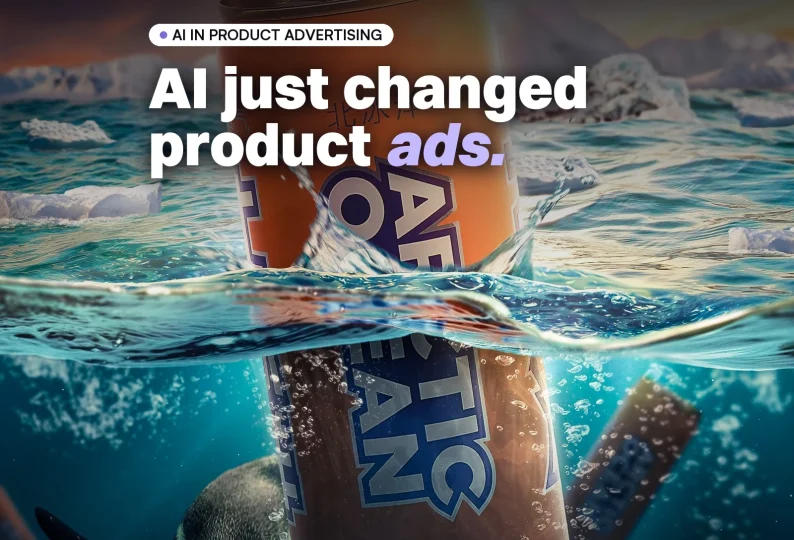
Every era of advertising has been reshaped by a new tool. The studio camera changed how products were captured, desktop design changed how campaigns were built, and social media changed where brands meet their customers. AI product advertising is the next shift, and it goes much further than “making images faster”.
The real change is in the creative process itself. AI changes how brands explore ideas, test concepts and turn one product into an entire campaign. It does not replace taste, strategy or art direction. It makes them matter more.
Key takeaways
- AI’s biggest advantage is exploration: testing ten creative directions before committing to one.
- One well-made product asset can now power a website, marketplace listing, social ads and video.
- Generic AI content erodes trust. Human direction is what turns AI output into premium advertising.
- The winning workflow is hybrid: strategy and art direction from people, speed and scale from AI.
Advertising Is Entering a New Creative Era
For decades, a premium campaign followed the same expensive path: concept, moodboard, production plan, location, crew, shoot, retouching. Each step took weeks, so most brands could afford to explore only one idea and hope it was the right one.
AI compresses the distance between an idea and a picture of that idea. A creative director can now see a concept rendered in hours, not after a shoot. The major ad platforms have moved in the same direction. Google, for example, added generative AI asset creation to Performance Max so advertisers can produce and test image variations inside their campaigns.

The Biggest Advantage: Creative Exploration at a New Speed
Previously, a brand would choose one creative direction because producing several was too costly. Now a brand can explore entire visual worlds before spending a cent on production:
- A fragrance brand can compare a desert dawn, a rain-soaked city and a sunlit botanical set side by side.
- A skincare line can test clinical minimalism against warm, sensory lifestyle moods.
- A tech product can trial architectural, futuristic and everyday-life settings in one afternoon.
This doesn’t mean every idea should become an ad. It means the idea that does become an ad has beaten nine others, and that is how stronger campaigns are found.
AI Is Not Replacing Creativity. It Is Expanding It
A model can generate possibilities, but it cannot understand a brand’s purpose, its customers or its positioning without direction. The gap between average AI content and exceptional AI advertising is the same gap that has always existed in creative work: strategy.
A brand does not become memorable by producing more images. It becomes memorable when every image communicates something specific. AI accelerates exploration; human judgement decides what deserves to exist.
From One Product to an Entire Advertising Universe
Modern brands need more content than ever. A single product launch can require:
- a website hero and product page gallery,
- Amazon or marketplace listing images,
- paid social ads in several aspect ratios,
- short-form video and motion stills,
- email, launch and retail materials.
Traditional production struggles to keep up with that volume. An AI-assisted workflow built on an accurate product asset, often a 3D model of the product, can expand one campaign idea into dozens of on-brand executions, each tailored to its platform and audience.

Why Human Direction Still Decides the Result
As AI tools become universal, the new challenge is making content that feels intentional. The same technology that makes production easy also makes generic content easy. The brands that stand out will not generate more; they will direct better.
Premium AI advertising still depends on:
- A clear message: one idea per image, not five.
- Art direction: light, composition, palette and props chosen on purpose.
- Product accuracy: correct shape, materials, colors and label details in every frame.
- Brand consistency: a visual system that holds across every channel.
- Quality control: checking every output at full size for artifacts, warped text and errors.

Why Low-Quality AI Content Will Not Build Premium Brands
There is a big difference between using AI to create more and using it to create better. Shoppers are increasingly good at spotting artificial-looking content: melted lettering, impossible reflections, plastic skin, products that change shape between images. Each of those flaws quietly tells the customer the brand cut corners.
Premium brands need control. That is why the future belongs to hybrid workflows that pair AI’s speed with professional creative direction and a rigorous review process. The technology creates possibilities; the creative process creates value.
The Future of Product Advertising
Advertising will be defined by flexibility: more ideas tested, more variations launched, richer stories told across more channels. The principle underneath will not change. People connect with ideas, not with technology.
The brands that win will combine speed with taste, innovation with strategy, and technology with human creativity. If your product images are already struggling to communicate value, start with why great products fail with weak visuals.
Frequently Asked Questions
Will AI replace product photographers and designers?
No. AI replaces some production steps, not creative judgement. Briefing, art direction, product accuracy and quality control still need experienced people, and they matter more as AI content becomes common.
Is AI-generated advertising allowed on Amazon, Google and Meta?
Yes, within each platform’s policies. Images must still represent the product accurately, and some platforms label or ask you to disclose AI-generated content. Check the current rules for each channel before launch.
How do you keep AI ads on brand?
Start from an accurate product reference, define a visual system (palette, lighting, typography, composition), generate several candidates per image and review every one at full size before it is published.
Conclusion
AI is changing how product advertising is made, but creativity remains the foundation. The goal isn’t more content; it’s stronger work that helps customers understand, trust and remember your brand. At AmplifySSV, I combine AI-assisted workflows, 3D visualization and strategic art direction in my product visualization services.
Request a free concept image or browse my recent work to see the standard I hold every image to.
Want to see this in motion? Explore my AI product animation and video ads, made with 3D, AI and human art direction.
Selling on Amazon? Here’s how to plan an Amazon product video that sells, from the first 2 seconds to the end card.

Abdenour is the founder and creative director of Amplify SSV, where he creates 3D product renders, Amazon listing images, product animation and packaging design for consumer brands. More about Abdenour.


